Showing posts with label Engineering. Show all posts

February 09, 2022

Trends in Architecture, Engineering, and Construction Industry 2022

Trends in Architecture, Engineering, and Construction Industry 2022

Trends in Architecture, Engineering, and Construction Industry 2022


The Architecture, Engineering, and Construction (AEC) Industry is evolving with digital technologies, which is shaping the future of the industry. Over several years AEC industry is stabilized and developed with the help of Building Information Modeling (BIM) and Internet of Things (IoT), which streamlines the operational processes and workflows. 2022 holds significant changes in the industry.

Virtual Design and Construction (VDC) and Digital Twins

With the help of advanced internet technologies, VDC and digital twins help to monitor, control, and optimize work remotely in real-time. VDC differs from BIM by managing the project. BIM is a shared resource of the project. Whereas VDC, in addition to having access to the shared document, can predict the performance of the project in comparison to the measured performance. It helps to assess the achieved objectives and reduces work duration and manpower.

Digital Twin is a fully-automated data transfer of the performance of the system in real-time. The digital twin transfers 3D model, digital rendering, and animation or simulation of the AEC plans. In short, it is an automated digital representation of the physical data, process, or system facilitated through IoT connectivity. It helps the stakeholders to visualize a project even before it is built. And real-time capture of the status of the building helps the team to monitor the performance and progress.

Artificial Intelligence (AI)

AI is used in engineering applications and software for generative design, Robotic Process Automation (RPA), and material selection.

Generative design, an iterative process, is what an engineer uses to design the size and strength, or measure constraints. They would ask the AI to create some options based on them. Also, AI selects materials and code compliance of traffic, pedestrian walks, residential buildings, and other constructions.

RPA allows system to automate the administrative processes and tasks like verifying the orders, managing the bills of the ordered bills, etc.,

There is also a huge advantage of AI being integrated into VDC and digital twins for easy processes and management. There is research going on to integrate them.

Sustainable Buildings

The world is at the high point that everyone should consider sustainable living to protect the environment and subsiding the potential dangers. Some of the changes that are practiced are reducing carbon footprint and trying alternate to fuels.

AEC Industry is not an exception. The industry is searching for ways to build sustainable buildings and constructions, that have less effect on the environment, either short-term or long-term. Some of the solutions are green rooftops and green alleys, which use recycled materials for permeable concrete – a system to absorb storm water. 

Another concrete material is called bio concrete, which has bacteria mixed into it. This is a self-healing component when the concrete cracks, aiding in the maintenance of the constructions.

Usage of the internet, advancement of technology, and enhancing sustainability are inevitable to any industry. The AEC industry has high scope to improve in these areas in 2022.

September 15, 2021

Happy Engineers Day - 2021


Happy Engineer's Day

#VeeTechnologies’ #AECsolutions deliver accuracy and competency by cutting-edge technology to produce industry-best results.


Email : info@veetechnologies.com

Website: www.veetechnologies.com

June 28, 2021

Top 4 Civil Engineering Trends to Watch Out in 2021 and Beyond

  Top 4 Civil Engineering Trends to Watch Out in 2021 and Beyond

Top 4 Civil Engineering Trends to Watch Out in 2021 and Beyond

With the recent pandemic impact and evaluating cope up strategies, the civil engineering sector is all set to undergo major changes in the years to come. Advancement in technology is the force that is driving huge changes in this industry sector. Some of the technologies, which once seemed too complicated to be implemented, are now creating new waves in the mainstream industry. 

Over the past few years, the focus of this industry sector was heavily towards creating energy-efficient building using smart materials. However, the recent global turbulence has caused the civil engineering sector to emphasize other technologies such as computer vision, sustainability, IoT, 3D printing and Virtual Reality, which are gaining prominence.

We are provided you with a mix of all the advanced technologies being used in civil engineering, which are expected to become the latest trends.

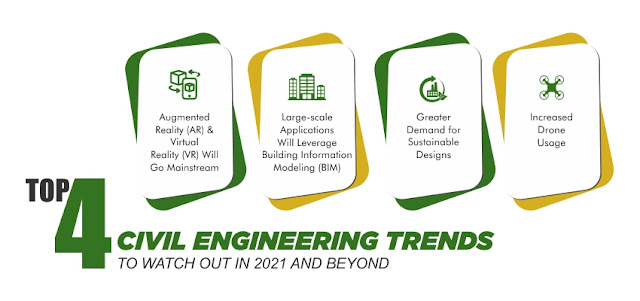
1. Augmented Reality (AR) & Virtual Reality (VR) Will Go Mainstream

AR and VR are two well-known technologies in civil engineering, the use of which is expected to boom like never before. While this technology is not new, the potential of its application in civil engineering and construction will be completely explored now. AR and VR are immersive media and can be used to envision the final results by both – civil engineers and end-users. Therefore, designers and stakeholders are now benefiting from this immersive and interactive experience that is created using sophisticated VR techniques.

2. Large-scale Applications Will Leverage Building Information Modeling (BIM)

BIM tops the list of innovative technologies, above Big Data and Cloud technology, when it comes to innovation in civil engineering and construction. Engineers are now leveraging intelligent 3D modelling to develop virtual models of various architectural designs. This is a futuristic technology that speeds up the overall time needed to transform the drawings of the buildings into reality. Electricity networks, superstructures and the construction of bridges are now speeding up with the availability of the virtual models of the actual designs. This opportunity to visualize the complete design at the very beginning is making the entire design process highly streamlined and cost-efficient.

3. Greater Demand for Sustainable Designs

The demand for sustainable designs is expected to shoot up significantly in the civil engineering sector, making it one of the biggest trends to watch out for. This is a trend that is enjoying great support from the government as well as organizations worldwide. The availability of intelligent electrical grids, smart materials, revolutionary technologies and smart projects with embedded sensors are providing civil engineers with the necessary push to come up with forward-looking sustainable designs.

4. Increased Drone Usage

Over the past few years, the drone market has witnessed sturdy growth. This trend is only expected to rise in 2021 and beyond. As technological advancements are making drones highly reliable, the commercial usage of drones has now reached a new milestone. Currently, drones have made their way into the civil engineering sector and are making a huge impact on the design, development as well as survey of various civil engineering projects. One of the major instrumental uses of drones in this sector is to carry out safety inspections, as drones can easily access hazardous parts of a construction project and fetch data within minutes.

Watch Out for These Trends to Get Future Ready 

The ear of technological advancements in civil engineering is already here. The sooner businesses implement and leverage these technologies the higher will be their survival and subsequent success rate in this competitive industry. Support from the government and international laws for these trends is an added benefit that helps businesses in this industry sector to step up and take their business ahead.