Showing posts with label 3D BIM Design. Show all posts

August 09, 2022

Why Do Construction Projects Need MEP Design Services?


MEP Engineering is an umbrella of the construction industry focusing on mechanical, electrical, and plumbing works, irrespective of commercial, industrial, residential, or institutional construction projects. In simple words, they are the science of planning, designing, and managing the MEP aspects of a construction project. It is considered the Central Nervous System of the building as these aspects make the building a suitable and comfortable place for human stay. The companies working on MEP make the building interiors live able place.


MEP design services play a crucial part in making the space smart. Mechanical, Electrical, and Plumbing contractors work on the designs with the help of the software. Utilizing the software helps them to implement calculations, heating and cooling systems, energy efficiencies, management of facet facilities, and more. 


MEP designing is a comprehensive approach to the installation and management of utility networks and software and technological processes. MEP design services allow getting away from the inconsistent scheme of work that not only hampers the construction activities but also impacts the functionality of the building after construction.


High-quality MEP design services help in better plan implementation and eliminate the risks of errors. Let’s look at some of the crucial reasons to hire MEP design services to help you in construction activities.


Quality Material Selection

An efficient MEP design process reduces the cost of the MEP materials and equipment. The wrong material selection would lead to poor installation and eventually take a lot of maintenance at frequent intervals. The maintenance cost will overrun a proper design. 


Also, reworking is costly in finding the right equipment and managing delayed projects. MEP design services enable the contractors to avert risks from the design phase before it is built with brick and cement.


Customize Structure

Designing and optimizing the building layouts for the MEP system can cut down the cost of the overall project. Plumbing and electrical lines are complex moving for lengthy distances. Without proper optimization, every material and component are accounted for with labor cost thus the distribution system can incur heavy costs.


Better Scheduling for Cost Optimization

MEP design services extract the coordinated and clash-free 3D models through BIM, deliver clarity of MEP systems, and lead to cost savings in the long run. The contractors, designers, and engineers can generate accurate cost estimations for seamless and friction-free installation of the MEP designs.


Efficient Maintenance

Maintenance of the facilities is crucial after the construction is over. A well-planned and designed MEP system can help the facilities management and owners of the building equipped to manage and maintain the issues fast and efficiently. It also enhances the sustainability of the building and its performance.


To avoid MEP design inefficiencies, easy maintenance, and cost reduction, better planning, and MEP designs are crucial. An expert MEP design services could help you to reduce the issues in construction on a large scale.

April 27, 2022

Towards Sustainability: Methods to Use in AEC Sector


Global Construction Perspectives and Oxford Economics report that global construction output will grow by 85% by 2030 with a $15.5 trillion economy at a global level. China, the US, and India account for 57% of this global growth. When there is a large scope for construction, there is a high possibility for environmental consequences.

With environmental impact in mind, the AEC industry should move towards sustainable practices and prevent further damage to our already damaged environment. The industry needs to strike a balance between sustainability and cost-effective designs, which can improve construction productivity on the whole. The industry already moving towards sustainability. Here are a few insights on the effective sustainable methods:


Using BIM for Efficient Buildings

A revolution in a sustainable building is Building Information Modeling (BIM). BIM though is not promoted as a sustainable technology; it delivers a wealth of boosts to efficient construction that can potentially reduce the construction project’s environmental footprint.

For example, a 4D BIM can schedule data precisely into a 3D BIM design file, enabling the contractors to develop step-by-step project plans and start building. Any design can be intertwined with the details regarding its lead-time, contraction, installation, curing and drying, and other processes.

Scheduling helps the AEC companies to eliminate hurried last-minute on-site coordination and re-work, which can reduce waste. The less time the construction team spends on the worksite, the less time high-emissions machinery, and power-hungry tools would be used. This could reduce energy consumption at the site.

Recycling Building Materials

The builders can use “circular construction”, i.e., using recycled and reoptimized construction materials. The AEC companies are turning to BIM to facilitate circular construction. Demolition of the old building before beginning new construction projects creates tons of landfills. Using recycled materials not only reduces construction costs but also reduces greenhouse gas emissions produced when manufacturing materials like construction-grade steel.

European countries are using “material banks”, a temporary storehouse of demolished materials that can be used when needed.

Using Sustainable Concrete

Concreate is a synthetic material widely used in any kind of construction which is environmentally damaging as well. The manufacture of concrete alone is responsible for nearly 5% of global CO2 emissions. Contractors and many construction companies are exploring sustainable ways to reduce emissions with alternatives like plastic and other recyclables. This initiative could reduce the carbon-di-oxide emission by almost 50%

Challenges in Sustainable Construction

Adopting sustainable construction methods will not happen overnight. There are challenges like cost. There will be pressure on the AEC service companies to reduce the cost where possible.

Affordability was a greater concern in adopting sustainable methods. The clients are demanding a green building. But the construction companies fear that they might be caught in the middle of demand and high costs.

Benefits of Sustainable Buildings

·       Commands a 7% increase in assets value over the traditional building.

·       The sustainable building reduces or eliminates negative impacts on nature, by consuming less water and energy/natural resources.

·       They bring several economic and financial benefits, which include savings in utility bills and higher property value.

·       Sustainable building improves the health and well-being of the people who live in/ work in these buildings.

Moving towards sustainability is the need of the hour. The Architecture, Engineering, and Construction industry is moving to sustainable and green constructions which will hugely impact the environment positively. And everyone is considerate about nature and demands green space for themselves, which creates demand for the AEC services to move to the good option.

June 28, 2021

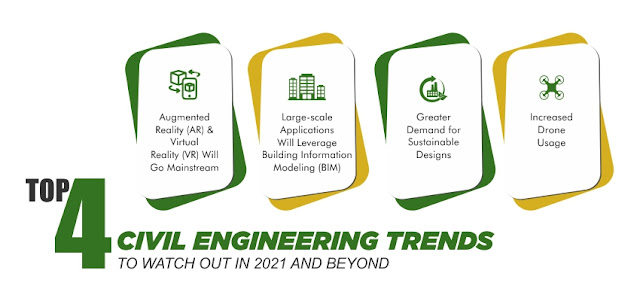
Top 4 Civil Engineering Trends to Watch Out in 2021 and Beyond

  Top 4 Civil Engineering Trends to Watch Out in 2021 and Beyond

Top 4 Civil Engineering Trends to Watch Out in 2021 and Beyond

With the recent pandemic impact and evaluating cope up strategies, the civil engineering sector is all set to undergo major changes in the years to come. Advancement in technology is the force that is driving huge changes in this industry sector. Some of the technologies, which once seemed too complicated to be implemented, are now creating new waves in the mainstream industry. 

Over the past few years, the focus of this industry sector was heavily towards creating energy-efficient building using smart materials. However, the recent global turbulence has caused the civil engineering sector to emphasize other technologies such as computer vision, sustainability, IoT, 3D printing and Virtual Reality, which are gaining prominence.

We are provided you with a mix of all the advanced technologies being used in civil engineering, which are expected to become the latest trends.

1. Augmented Reality (AR) & Virtual Reality (VR) Will Go Mainstream

AR and VR are two well-known technologies in civil engineering, the use of which is expected to boom like never before. While this technology is not new, the potential of its application in civil engineering and construction will be completely explored now. AR and VR are immersive media and can be used to envision the final results by both – civil engineers and end-users. Therefore, designers and stakeholders are now benefiting from this immersive and interactive experience that is created using sophisticated VR techniques.

2. Large-scale Applications Will Leverage Building Information Modeling (BIM)

BIM tops the list of innovative technologies, above Big Data and Cloud technology, when it comes to innovation in civil engineering and construction. Engineers are now leveraging intelligent 3D modelling to develop virtual models of various architectural designs. This is a futuristic technology that speeds up the overall time needed to transform the drawings of the buildings into reality. Electricity networks, superstructures and the construction of bridges are now speeding up with the availability of the virtual models of the actual designs. This opportunity to visualize the complete design at the very beginning is making the entire design process highly streamlined and cost-efficient.

3. Greater Demand for Sustainable Designs

The demand for sustainable designs is expected to shoot up significantly in the civil engineering sector, making it one of the biggest trends to watch out for. This is a trend that is enjoying great support from the government as well as organizations worldwide. The availability of intelligent electrical grids, smart materials, revolutionary technologies and smart projects with embedded sensors are providing civil engineers with the necessary push to come up with forward-looking sustainable designs.

4. Increased Drone Usage

Over the past few years, the drone market has witnessed sturdy growth. This trend is only expected to rise in 2021 and beyond. As technological advancements are making drones highly reliable, the commercial usage of drones has now reached a new milestone. Currently, drones have made their way into the civil engineering sector and are making a huge impact on the design, development as well as survey of various civil engineering projects. One of the major instrumental uses of drones in this sector is to carry out safety inspections, as drones can easily access hazardous parts of a construction project and fetch data within minutes.

Watch Out for These Trends to Get Future Ready 

The ear of technological advancements in civil engineering is already here. The sooner businesses implement and leverage these technologies the higher will be their survival and subsequent success rate in this competitive industry. Support from the government and international laws for these trends is an added benefit that helps businesses in this industry sector to step up and take their business ahead.